
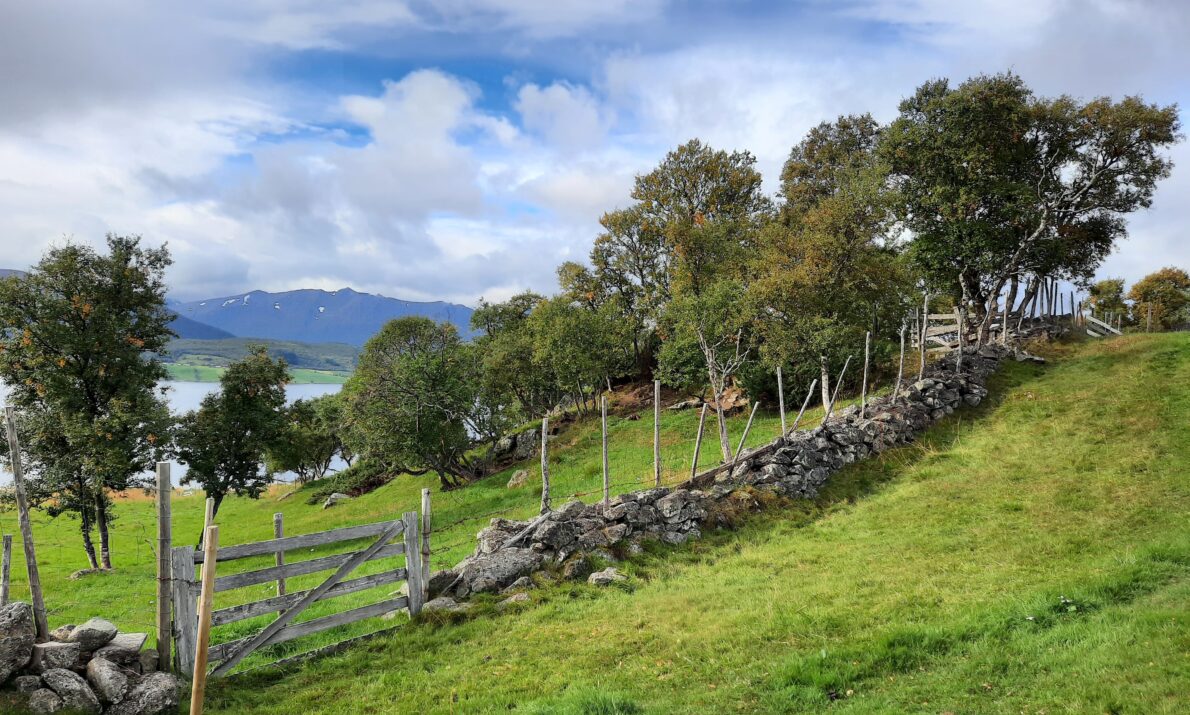
Photo: Marit Chruickshank, Troms fylkeskommune
From the Middle Ages through the 19th century, settlement at Borkenes developed around four farmsteads. Today, these homesteads are situated on four farm mounds along the main road, still featuring farmhouses, barns, and outbuildings. A marked cultural heritage trail runs through the beautiful agricultural landscape—from Skallan to Rå—featuring Iron Age burial cairns, farmsteads from more recent times, pastures, summer barns, and elaborate stone walls.
Practical info
Practical info
Opening hours
Always open
Parking
Yes
Restrooms
No
Visitor information
The trail begins at the Skallan parking area. From there, it is approximately 3 km to the viewpoint at Rå. Information signs provide details about the cultural heritage sites. The route follows a trail through open countryside and is not accessible for wheelchairs or walkers. The cultural landscape is shaped primarily by activities from the last few centuries, though there are occasional glimpses into a mysterious past. The cultural trail winds through this landscape, taking you across the boundaries between cultivated land and outlying pastures, and between fjord and mountain. Here, you can see the traces left by people and animals—from Iron Age graves to the sheep paths of today.
Accessibility
Accessibility
The trail is a wilderness path that is not accessible to wheelchairs or walkers.
The old farms of Indre Gåra, Ytre Gåra, Strand, and Rå lie in a row along the fjord. The main farmsteads are all situated on ancient farm mounds and boast a history stretching back a thousand years. In the mid-19th century, during the land consolidation process, the farms were subdivided, creating the agricultural landscape seen today. Long, narrow strips of land stretch from the shoreline to the foot of the mountain. Numerous stone walls mark the old property boundaries; the area also encompasses outlying hay meadows, forests, and peat bogs.
The earliest agricultural activity in Troms is found on Kveøya, just across the fjord. Artifacts from the Neolithic period bear witness to settlement dating back to approximately 4500 BC. There are several Iron Age burial grounds and cairns in the area, and the farm mounds contain thick cultural layers with remnants of centuries of continuous settlement.
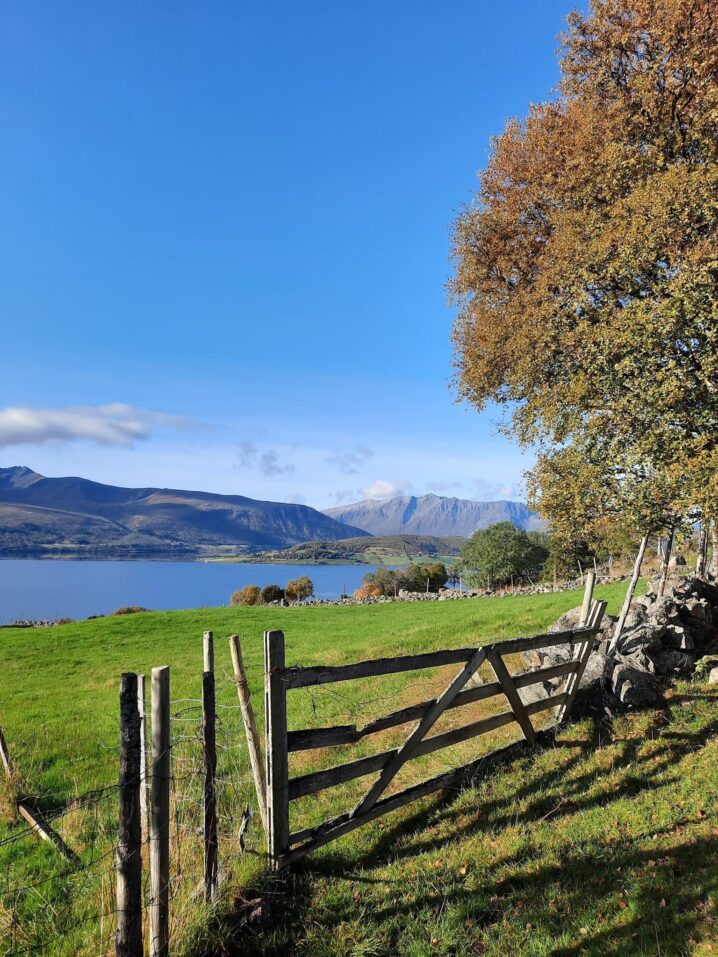
Summer barn
The population grew towards the end of the 19th century, leading to a shortage of arable land. Consequently, outlying pastures had to be utilized more extensively for grazing. This led to the widespread construction of summer barns—structures situated between the cultivated home fields and the outlying pastures—where animals were brought in for milking. The agile Nordland cow was perfectly suited for navigating the rugged terrain of the outlying pastures; however, as new breeds capable of producing more milk were introduced, those breeds became the preferred choice.
Agriculture subsequently underwent a major transformation, shifting towards the use of tractors and concentrated feed. The practice of using summer barns came to an end during the 1960s and 1970s.
Women were responsible for the work in the summer barns. The cows—most households kept three or four—had to be milked at the crack of dawn. Manure had to be shoveled out, and the milk carried back to the farmstead. In the evening, the cows were brought to the summer barns to be milked again. Today, several of these summer barns remain along the cultural trail, serving as a beautiful reminder of the "summer barn hamlet."
Fagerlin and Alperos
In the 1950s, the farms along the stretch between Gåra and Borkenes kept almost exclusively Nordland cattle. They bore names like Blomma, Fagerlin, Alperos, Litago, and Snehvit. Other farms kept Målselv cattle. Breeding was managed locally, involving local breeding associations and breeding bulls. In the late 1960s, Jermund and Tordis acquired their first NRF (Norwegian Red) cow, and soon this breed became virtually the only one found on farms in Kvæfjord.
