

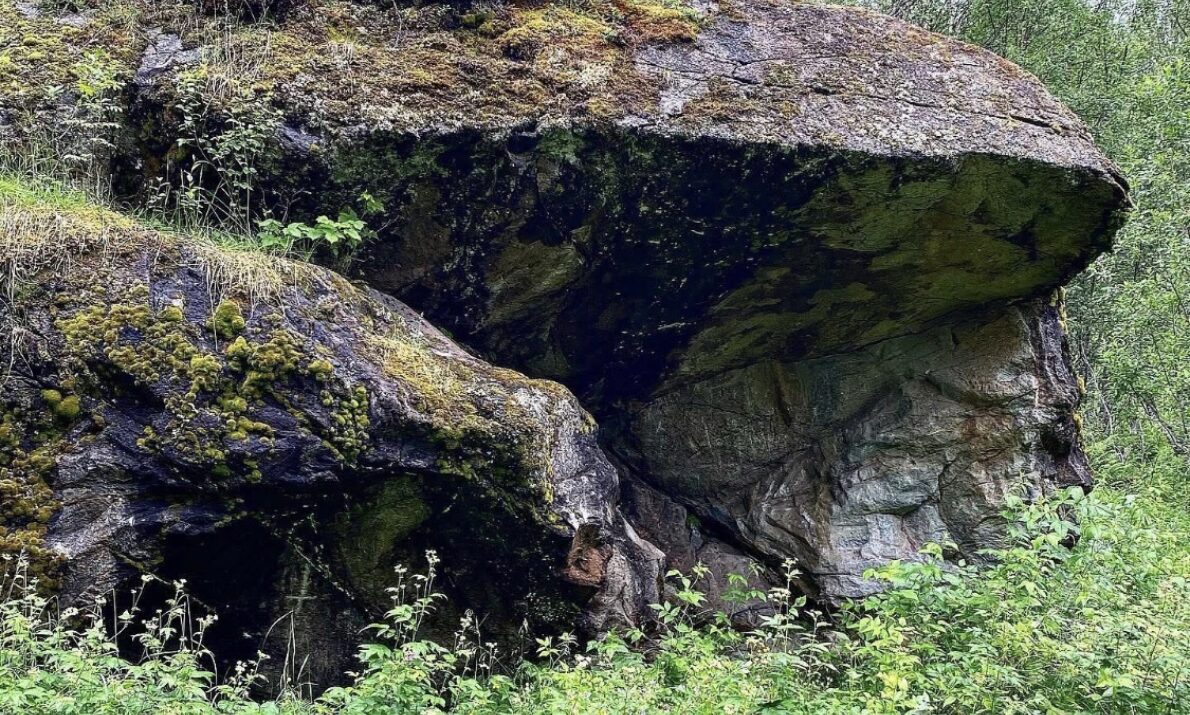
Photo: Midt-Troms museum
Talgrøtberget and the area around Straumen have long served as a central hub. The site features Stone Age settlements and several farm mounds, as well as both Norse and Sámi graves. Talgrøtberget is a soapstone quarry; traces of extraction here point to an industry that generated prosperity for the Straumen area around 700 years ago. A walk through the forest to Talgrøtberget makes for a lovely afternoon excursion.
Practical info
Practical info
Opening hours
Outdoors and always open
Parking
At Sørreisa Stadium
Toilets
No
How to get here
By car: From Sørreisa town center, drive towards Sørreisa Stadium/the football field on Kapellveien. You can park in the lot by the football field—at the very top of Kapellveien—and follow the hiking trails from there. Talgrøtberget is also signposted down on Kapellveien.
Accessibility
Accessibility
Not wheelchair accessible
Geology
In the forest above the cultivated fields on the sheltered southern side of Reisavatnet, we find a remarkable landscape. The bedrock is riddled with passages and deep holes. Water has carved these shapes into the easily soluble limestone, creating what geologists call a karst landscape.
Talgrøtberget is a small outcrop of soapstone rising directly from the ground; the limestone that once covered the rock has eroded away. With its distinctive profile, the outcrop is a striking landmark at the edge of the forest.
The use of soapstone
Traces remain in the bedrock of the many implements carved from the soft stone. Soapstone was versatile, used for items such as oil lamps, spindle whorls, casting molds, net sinkers, loom weights, cooking pots, and building blocks.
The word *talgrøt* (a local term for soapstone) likely derives from the Old Norse verb *telgje*, meaning to cut or carve. Soapstone is a type of rock that is soft and easy to carve. It has been an important resource for thousands of years. With the advent of metal production during the Bronze Age—or the early metal age—a need for casting molds eventually arose. Soapstone could withstand intense heat without cracking. It was also an important trade commodity.
The earliest settlement
A settlement once existed in a rock shelter beneath the cliff. Beneath thick layers of soil and stone, archaeologists have found traces of the people who lived here during the Stone Age. Knives, axes, and hide scrapers made of flint and chert have been discovered.
