
Photo: Marit Chruickshank, Troms fylkeskommune
The Saga Island in the Norse borderlands: The chieftain’s seat at Bjarkøy.
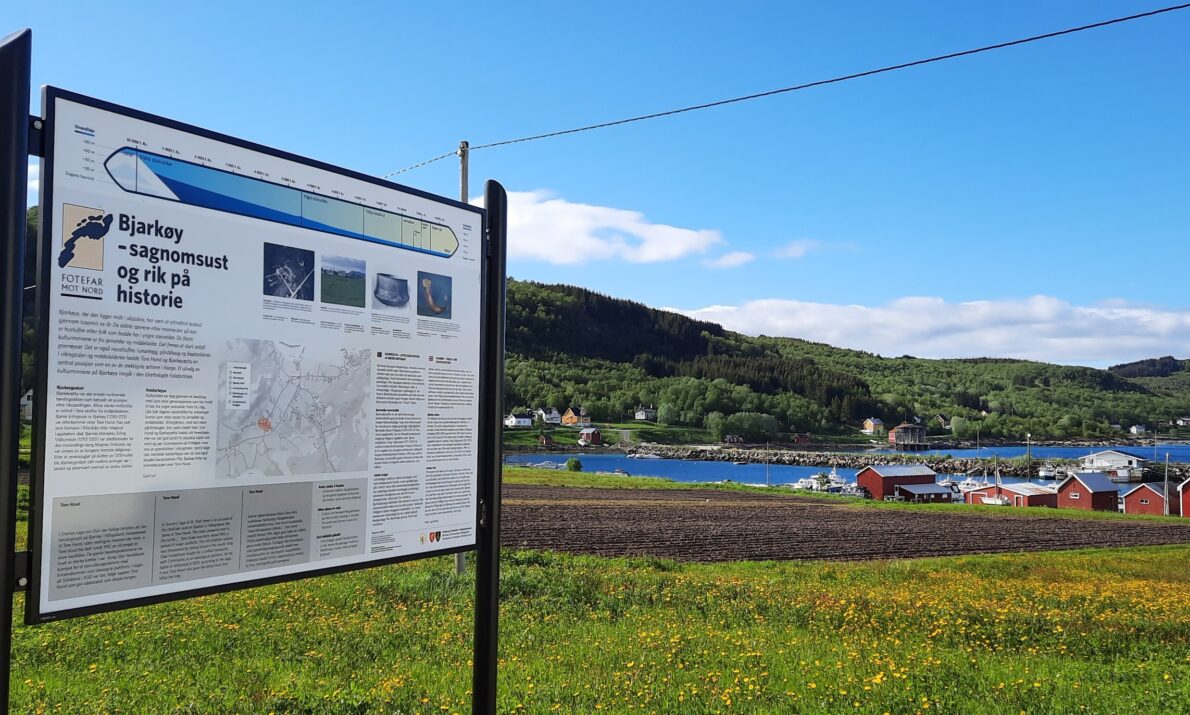
During the Viking Age and the Middle Ages, Tore Hund and the Bjarkøy clan held a central position as one of the most powerful families in Norway. The earliest traces of human activity on Bjarkøy are house foundations dating from the Neolithic period (4500–1800 BC). The island also features several Iron Age burial grounds, a farm mound, boathouse foundations, and well-preserved buildings from the 19th and 20th centuries. A selection of these cultural heritage sites is included in the developed "Fotefar" trail.
Practical info
Practical info
Opening hours
Outdoor site; open year-round
Parking
Parking available at the shop
Restrooms
No
How to get here
Drive from Harstad town centre to Storneset ferry terminal. Take the ferry to Bjørnerå on Grytøy and follow Road 8670 to Bjarkøy.
Other
You can explore several cultural heritage sites on Bjarkøy:
- Marked cultural heritage trail between Nergårdshavn and Austnes.
- “Batteriet” (The Battery) – a protected WWII site.
- Mining history: locomotive and railway tracks.
- Sålnesbrygga: the largest wharf with a net-drying rack in Troms.
- Krykkjeberget: a bird cliff in Sundsvollsundet.
Accessibility
Accessibility
Partially accessible to wheelchair users
The Fotefar trail
The cultural trail takes you through a landscape bearing traces of the generations that have lived here, from the Neolithic period to the present day. Just behind the current row of boathouses, archaeologists have discovered traces of large boathouses dating back to the Iron Age and the Middle Ages. Øvergården—with its large settlement mound—may well have been the seat of power for Tore Hund and the Bjarkøy clan. The site offered a commanding view of the shipping lanes to both the north and the south. The burial cairns at Frihågen offer insight into Viking Age burial customs. By following the marked "Fotefar" trail, you can also visit the standing stone known as Pila, Bjarkøy Church, and the memorial monument dedicated to Tore Hund.
Tore Hund
Snorri’s saga of Saint Olaf tells of the chieftain’s seat at Bjarkøy in Hålogaland, the home of Tore Hund—"the most powerful man in the north..." Tore Hund was born around 990, a time marked by major conflicts. The old chieftaincies were threatened by powerful forces from the south. King Olaf Haraldsson fought for a centralized monarchy with Christianity as its ideological foundation. According to the saga, it was Tore Hund who dealt the fatal blow that killed the king at the Battle of Stiklestad in 1030.
The Bjarkøy Estate
The Bjarkøy family was the only Northern Norwegian chiefly clan to retain its position following the unification of the realm. The family's considerable influence is documented in several medieval texts. Bjarne Erlingsson of Bjarkøy (1250–1313) was a descendant of Tore Hund; he served as chairman of the Council of the Realm after the death of Magnus the Law-mender. Bjarne’s nephew, Erling Vidkunsson (1292–1355), acted as regent for the underage King Magnus Eiriksson and later became one of the king’s foremost advisors. Following a division of the estate in the late 14th century, the Bjarkøy holdings were split among heirs in the south of the country and eventually passed into the hands of other families.
