

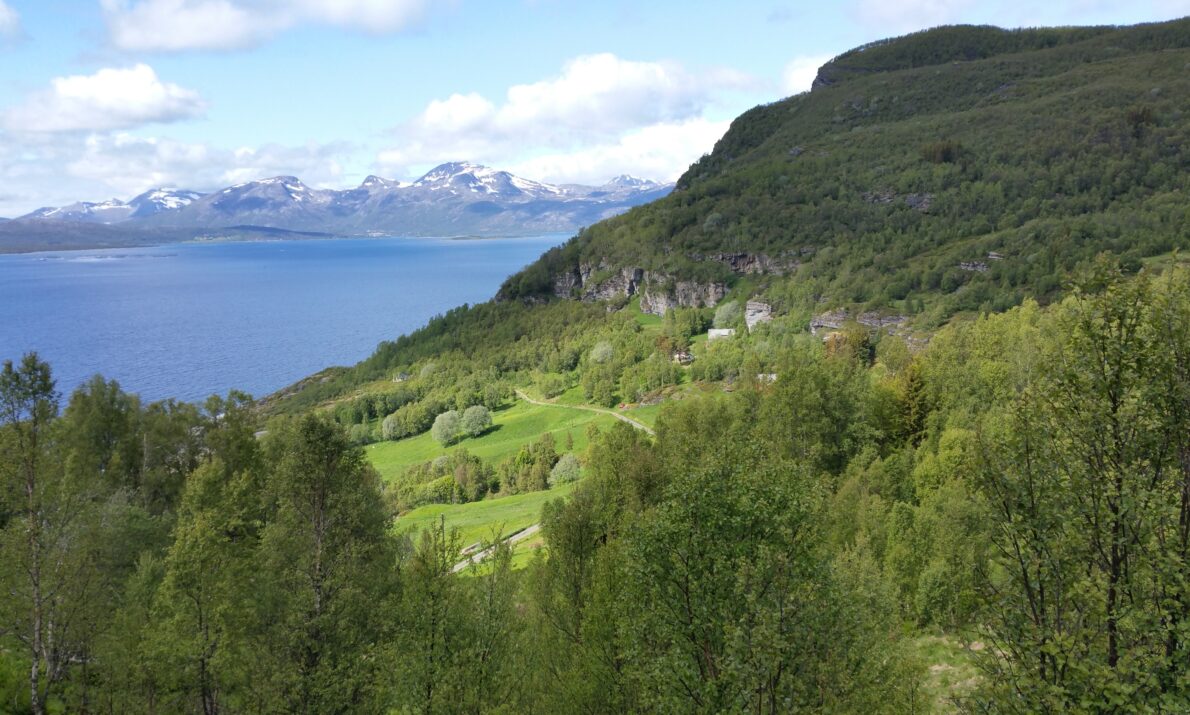
Dyrøya.
Photo: Marit Chruickshank, Troms fylkeskommune
An old island community – right in the heart of the shipping lane.
Visiting Dyrøya is a journey back in time. The island has been inhabited since the Stone Age and is rich in cultural heritage sites. If you have plenty of time, cycling around Dyrøya is a great option – perhaps combined with hikes along the island's trails. Unfortunately, some of the cultural heritage sites suffer from overgrowth and a lack of maintenance, yet you can still enjoy wonderful nature and cultural experiences here.
Practical info
Practical info
Opening hours
Always open
Parking
Yes
Toilet
No
How to get here
By car:
Dyrøya is located in Solbergfjorden, between Senja and the mainland. The Dyrøy Bridge connects the mainland to Dyrøya.
By express boat:
The express boat between Tromsø and Harstad stops at Brøstadbotn, approximately 5 km from the Dyrøy Bridge. It is possible to bring a bicycle on the express boat.
By bus:
See Svipper – journey planner
Accessibility
Accessibility
Most paths are wheelchair accessible.
Dyrøy Church
The church at Dyrøyhamn is first mentioned in written sources from 1589, whereas the farm is mentioned as early as 1370. Rich fisheries during the late Middle Ages funded the church and beautiful ecclesiastical art. When the fisheries failed, it had consequences for the church as well. By 1770, the church was in such poor condition that it was demolished.
Holm became the new church site in 1777. A small cruciform church was initially erected there. In 1805, this was replaced by the new (and current) long church. Several beautiful objects that had belonged to the medieval church at Dyrøyhamn were transferred to the church at Holm, including a velvet chasuble and a silver crucifix.
The Mikkelbostad–Hagenes area
Mikkelbostad is situated at the southernmost tip of Dyrøya, well-sheltered from north-westerly winds. Various archaeological finds dating back to the Neolithic period confirm the area's long history of continuous settlement. The farm Miklibostadr is first mentioned in written sources from 1567; however, dating of the farm mound indicates that the land was first cleared as early as the 13th century.
At Hagenes, there are house foundations from the Neolithic period, as well as a burial site containing seven cairns from the Iron Age. During the Iron Age, it was customary to place burial cairns in prominent locations within the landscape, often with a view of the shipping lanes. Today, the cultural heritage sites at Hageneset can be difficult to spot due to overgrowth.
Hagenes is also home to a coastal fortification from World War II. The area is a popular destination, offering beautiful scenery and spectacular views of the sea and mountains.
The Vinje farmstead today comprises several holdings. It features a rich cultural landscape with traces dating back to the Iron Age and buildings spanning from the 19th century to the present day. The school at Vinje closed in 1966 and now serves as a local school museum, with its original furnishings and equipment still intact.
From Skogshamn to Storelva
There has also been settlement on the outer side of Dyrøya as far back as the Neolithic Age and through the Iron Age and the Middle Ages. After the Black Death, the farms were abandoned until the area was used again in the 18th century. Along the old road between Skogshamn and Storelva you can walk in beautiful countryside and see cultural relics from early settlement on the outside.
The Platinum Fox from Dyrøy
It is not without reason that the fox adorns the coat of arms of Dyrøy Municipality. In 1933, Mons—a platinum fox that was half platinum and half silver fox—was born at Vinje. This type of fur was in high demand, and at an auction in New York, a single pelt sold for 11,000 dollars! Such mutants played a hugely significant role in mink farming. Mons from Vinje triggered a massive revolution in global fur-bearing animal breeding.
