
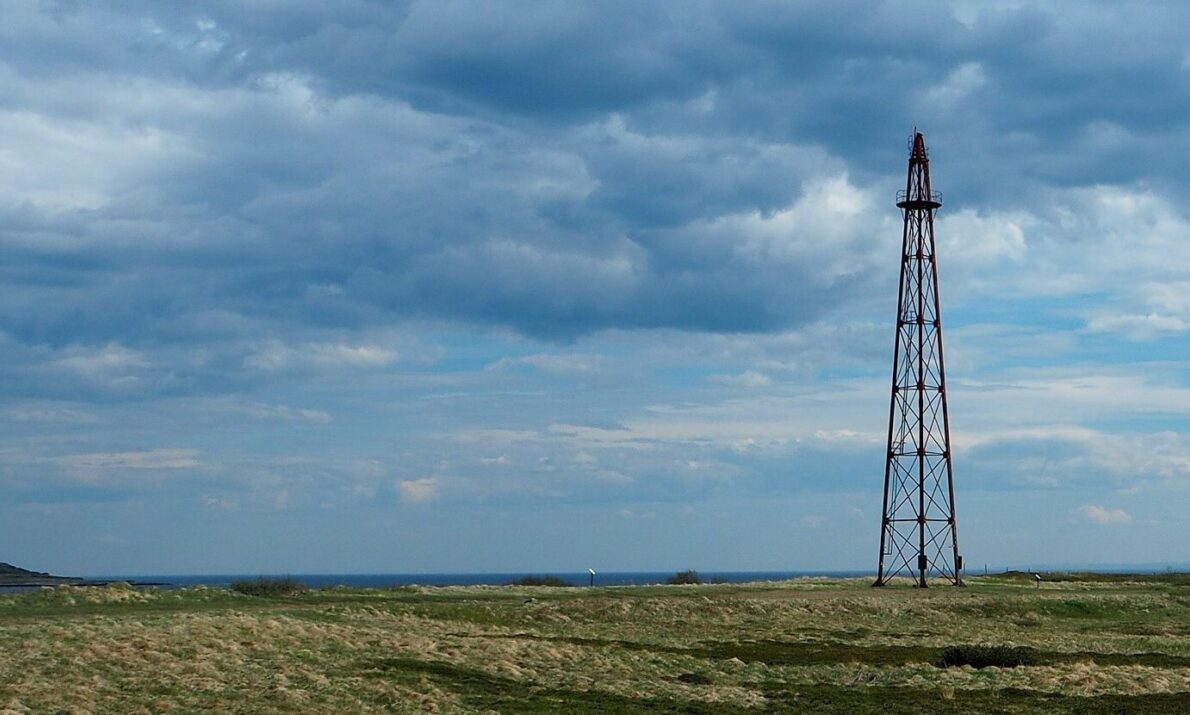
The airship mast.
Photo: Varanger museum
Vadsøya cultural park contains the sources of the city's oldest history, and a number of other cultural monuments from ancient and modern times. Polar history is central, with the airship mast as a well-known landmark. Vadsøya is also very rich in bird life and is an important wetland area for ducks and waders.
Practical info
Practical info
Opening hours
Outdoor area, open all year round.
Parking
There is a parking lot adjacent to the cultural park.
Toilet
There is no toilet available on site
How to get here
The cultural park is located approx. 500 meters from the center of Vadsø, and can be reached on foot, by bicycle or car.
Other
Hiking opportunities: There are shelters with barbecue opportunities in the cultural park. Vadsøya cultural park is also registered as Perletur.
Museum website: Vadsøya cultural park | Varanger museum
Accessibility
Accessibility
There is a gravel walkway throughout the park, and signs are available along the walkway. The cultural trail is approx. 1.8 km long, runs on flat terrain and is suitable for wheelchairs and strollers. The walkway is not plowed in winter. Remember to keep dogs on a leash in the park, as there are both nesting birds and grazing sheep.
"Medieval town"
The most extensive cultural monuments in the park are the sites of Vadsø's early fishing village settlement from the Middle Ages, and the town is considered a precursor to Vadsø town. There were settlements here between about 1450 and 1600, and are now visible as clear ramparts and depressions in the terrain. These show how turf houses have stood in clusters, and that the construction has provided protection from the weather and wind. Archaeological finds from the sites have shown that fishing and livestock were important, and that the islanders had access to trade goods from a wide area in Europe. The island was a courthouse and church, and the weather was one of the best in Finnmark at the time.
The cemetery and church site at the entrance to the cultural park are also part of the medieval town. After the settlement on Vadsøya moved to the mainland, the cemetery was used by Russian traders and sailors, and is therefore also called the "Russian cemetery".
Polar history
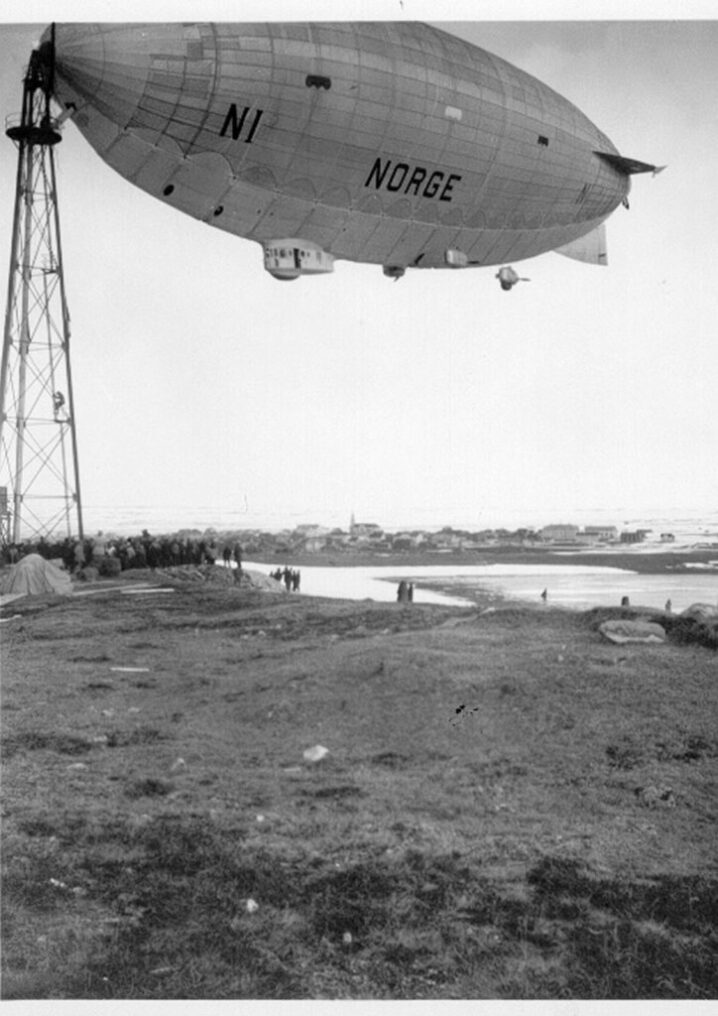
Easily visible on Vadsøya is the airship mast, which is the only one of its kind on the European mainland. The 1920s were a breakthrough time for aviation. Polar explorer Roald Amundsen, the Italian general, polar explorer and airship constructor Umberto Nobile and the wealthy American engineer Lincoln Ellsworth put together a plan to "conquer" the North Pole with airships. The mooring mast was constructed by Nobile and it served as a landing site in connection with their joint journey over the North Pole with the airship "Norge" in 1926. Nobile also stopped here in 1928, on his journey with the airship "Italia".
Sports and leisure
Remains of sports facilities and a trotting track show different aspects of life in the interwar period and immediately after World War II. In the interwar period, sports in Norway were divided, as a result of political tensions in society. In Vadsø, this resulted in the Vadsø Workers' Sports Club not being able to access the stadium in the city. The sports club therefore chose to establish a track on Vadsøya, despite the fact that this required the use of a boat. The trotting track is still clearly visible, and was established immediately after World War II, when the island was connected by a bridge. Trotting events were held here until the 1950s, which were pure folk festivals.
War memorials
In the cultural park there are remains of bunkers, cannon positions and trenches. These are traces of German occupation during World War II. During the war, Vadsø was the main base for the "subsection North Varanger". After the German attack on the Soviet Union in June 1941, a large-scale development of German fortifications was initiated in Finnmark. Around Vadsø, a number of smaller structures were erected for close defense of the city, partly as part of the fortification along the Varangerfjord. The structures in and near Vadsø were often collectively referred to as Festung Vadsø.
Sami sacrificial site
The oldest Sami history associated with Vadsø is primarily embodied in legendary material. Finnkirka, a cave in the rock west of the island, is referred to by several older authors as a Sami sacrificial site. It was destroyed during work on the port facility. Another rock formation on the southwestern part of the island partly took over the name and legendary material. This has also been named "Russekirka" in connection with the Pomors who visited Vadsø.
Svend Foyn's whaling station
On the northwest side of the island, Svend Foyn established the world's first modern land-based whaling station in the 1860s. He thereby laid the foundation for modern whaling. The station, with factories, workers' housing, a pier and a whaling station, was located centrally by the harbor basin. Unfortunately, there is no trace of the whaling station today.
